Chabad in the News
The Vienna Connection, April 2-8, 2014
http://www.viennaconnection.com/news/2014/apr/01/hosting-community-passover /
Hosting Community on Passover
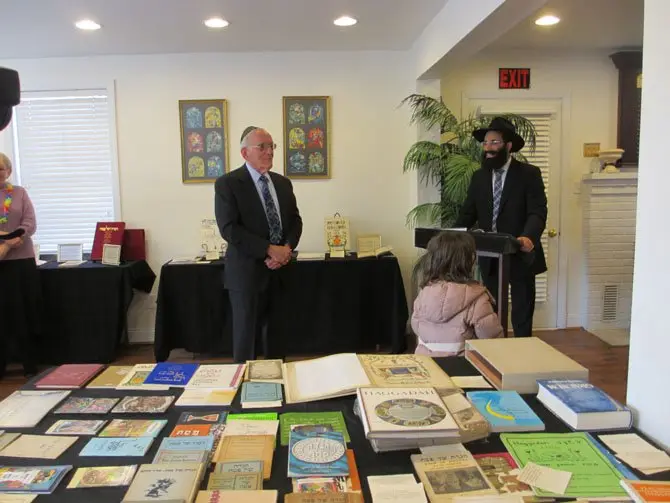
March 21 reception recognized donation of 100-plus Haggadot from Mike Berger of Vienna.
On March 21, Rabbi Chessy Deitsch of the Chabad Tysons Jewish Center thanked Vienna resident Mike Berger for his donation of more than 100 Haggadah to the center. The collection belonged to Berger’s father. Photo by Donna Manz .
Passover Seder at Chabad Tysons Jewish Center Open to All
Passover or Pesach celebrates the deliverance of the Jewish people from slavery in Egypt. The sacred holiday begins sunset of Monday, April 14, and ends nightfall of Tuesday, April 22. The commemoration begins with the Passover ritual, the Seder, in which followers of the Jewish faith read from the family Haggadah, breaking for a traditional feast. At its core, the Haggadah narrates the story of the Exodus from Egypt.
On March 21, the Chabad Tysons Jewish Center, in Vienna, recognized a donation of more than 100 Haggadot [Jewish texts] from Mike Berger, a Vienna resident whose father collected the versions throughout his lifetime.
THE CHABAD TYSONS JEWISH CENTER is a close-knit community that welcomes newcomers as warmly as it welcomes old friends. And on Monday and Tuesday, April 14 and 15, the Chabad Tysons invites Jewish and non-Jewish neighbors to participate in the Passover Seder experience.
"Everyone is welcome," said Rabbi Chessy Deitsch. "The Chabad Seder is like family; it’s home away from home." Rabbi Deitsch promised a warm environment, a "delicious" catered traditional Seder dinner, insights, singing, four cups of wine, and Matzah. "Whether you are a Seder veteran or a curious explorer, the Chabad Seder offers a stimulating and satisfying experience," Rabbi Deitsch said.
The Seder, which means "order" in Hebrew, follows a traditional protocol. The leader of the Seder leads the prayers and songs and the Haggadah is passed from guest to guest who recites passages. Sometimes, children act out a vignette.
The first known completed manuscript of the Haggadah was written in the 10th century. In 1482, with the introduction of the printing press, the first printed Haggadah was produced and is now housed in a Jerusalem library. The story of the emancipation of the Israelites is a story of plagues and of faith, of suppression and of freedom.
The eight-day festival of Passover is celebrated in the early spring, from the 15th through the 22nd day of the Hebrew month of Nissan. After more than 200 years of enslavement to the Egyptian pharaohs, God sent Moses to Pharaoh with a message, "send forth my people, so that they may serve me." When God visited the last of the plagues upon the Egyptians, he "passed over" the home of the children of Israel, sparing them. The Israelites fled, taking with them their unleavened bread. Matzah is central to the Seder dinner.
READING THE HAGGADAH at the Seder table fulfills the commandment to recount to new generations the story of the Israelites’ Exodus from Egypt. For many local Jewish families, it’s a living heritage.
"Judaism is both a religion and a culture," said Steve Hyatt of McLean. "The Chabad embraces the cultural side of the people."
Hyatt’s family comes to the Chabad Tysons Jewish Center the first night of Passover. The second night is spent at the Hyatt home, a "more intimate" personal experience, said Hyatt. There’s a lot of symbolism in the Haggadah, he said.
"The main thing of the Seder is that it shares the story of your people; you learn what your roots are," Hyatt said.
To RSVP to the Passover Seder or for more details, email [email protected] or call 703-821-7770. To learn more about Chabad Tysons Jewish Center, visit www.ChabadTysons.com .
Passover Seder at Chabad Tysons Jewish Center Open to All
First Seder Night, Monday, April 14, begins at 7:30 p.m.; second Seder night: Tuesday, April 16, begins at 8:30 p.m.
Chabad Tysons Jewish Center, 2107 Chain Bridge Road, Vienna, 22182 (corner of Chain Bridge Road and Horseshoe Drive). RSVP 703—821-7770. Hosted by Chabad Tysons Jewish Center, Rabbi Chessy Deitsch.
For more details, email rabbi@chabadtyson... . To learn more about Chabad Tysons Jewish Center, visit www.ChabadTyson.com .
THE WASHINGTON POST, Sunday, May 27th, 2007
http://www.washingtonpost.com/wp-dyn/content/article/2007/05/26/AR2007052600955_pf.html
The Offbeat Is Helping Some Jews Reconnect Chabad Rabbis' Modern Outreach Methods Are Controversial but Forge Ties
By Jacqueline L. Salmon Washington Post Staff Writer Sunday, May 27, 2007; C01
With ice cream sundaes, iPod giveaways, spa days and yoga classes, a group of Orthodox rabbis in the Washington area is employing decidedly unorthodox methods to address a growing problem: the fading involvement of Jews in local Jewish life.
Although the region has one of the largest and youngest Jewish communities in the country, recent studies have found that a shrinking proportion of Jews— as elsewhere in the country — is joining synagogues, community centers, Jewish schools and other centers of Jewish life.
However, Chabad-Lubavitch, a controversial 250-year-old branch of Judaism with mystic roots, has significantly increased its presence in the area in the past five years. During that time, five gathering places — called Chabad Houses — have opened: two in Northern Virginia, two in northern Montgomery County and one in Annapolis. Rabbi Shmuel Kaplan, regional director of Chabad-Lubavitch of Maryland, said the movement expects further expansion.
"People ask me who our target audience is," he said. "It's every single Jew in metropolitan Washington."
With their black hats, thick beards and long, black coats, male "Chabadniks" look like throwbacks to Old Europe. They are part of the movement called Hasidism, whose members — men and women — ordinarily live apart from mainstream society to shelter their beliefs and practice.
Not the followers of Chabad (pronounced similarly to 'kah-BAHD'). The Brooklyn-based group emphasizes outreach to practicing and non-practicing Jews.
But the group has also engendered deep resentment from many mainstream Jews, who regard them as hovering on the far fringes of the faith.
Although Chabad-Lubavitch practitioners do not seek to convert non-Jews, mainstream Jews regard their outreach as evangelizing, a practice frowned upon. Critics also dismiss Chabad's outreach as superficial and say its leaders are too quick to claim success.
"They're offering a motel Judaism, not a home Judaism," said Jacob Neusner, a professor and senior fellow at Bard College's Institute of Advanced Theology in New York. "They rely on intense experiences which last for a little bit of time and don't really have a permanent effect."
Another source of controversy, inside and outside the movement, has been the belief on the part of some followers of Chabad that a revered leader, Rabbi Menachem M. Schneerson, who died in 1994, will return as the Messiah.
Despite the strife, Chabad is one of the fastest-growing major movements of Judaism, said Jonathan Sarna, professor of American Jewish history at Brandeis University. In the past decade, the number of Chabad's emissaries has doubled worldwide to 4,000 rabbis and their families, said Rabbi Zalman Shmotkin, a national Chabad spokesman.
In the Washington area, where Chabad has operated since the 1970s, there are 13 Chabad Houses, offering a mix of New and Old World programs to draw in Jews who are not affiliated with synagogues. Chabad Houses — which are funded by donations, not membership dues — schedule worship services, religious classes for adults and children and holiday celebrations.
The Chabad Center of Potomac holds a periodic "spa for the soul" day for women featuring pedicures, cooking lessons and Torah study. The Chabad of Anne Arundel County runs a kosher delivery service — http://www.kosherkaptain.com -- for the growing Jewish community there. In December, the Chabad House in Tysons Corner hosted a "Hannukah Wonderland" party in an office building, which attracted 2,500.
Last fall at Chabad of Silver Spring, Rabbi Berel Wolvovsky offered a free iPod to any child who attended his new Sunday morning Hebrew classes. This month, Wolvovsky presented eight children with their iPods.
"We could have given a discount to the parents for the tuition," Wolvovsky said. But, he added, "our objective was that the kid should be excited about school."
As in other Jewish communities in the country, local leaders are concerned lagging enthusiasm for social and religious organizations.
A 2003 survey found that although 90 percent of Washington area Jews reported engaging in individual religious practices — observing Passover and lighting Sabbath candles, for example — measures of participation in communal Jewish life are alarmingly low.
Just over a third of local Jewish households said they belonged to a synagogue— well below the average for 50 other Jewish communities nationwide, according to the 2003 survey, commissioned by the Charles I. & Mary Kaplan Family Foundation.
Enrollment in Jewish preschools and day schools was also well below average in the Washington area compared with other similarly sized Jewish communities. And a relatively high proportion — 41 percent — of marriages among Jews were found to be interfaith. Even more worrying to Jewish leaders was the finding that just one-half of area Jews said they felt a part of the local Jewish community.
Misha Galperin, chief executive of the Jewish Federation of Greater Washington, calls that a crisis.
"Unless we figure out how to handle it," said Galperin, "the sense of us being a community of people who are connected to each other, to a set of values, is very much threatened."
A 2004 study by the Jewish Outreach Institute laid the blame for the low participation at least partly on local Jewish organizations' outreach, particularly to singles and families consisting of both Jewish and non-Jewish faiths.
Costs of memberships at synagogues and community centers are often high, it said. And some newcomers have been met with "apathy or boredom, or worse, rudeness or even hostility."
To combat the problem, the Jewish Federation launched a multimillion-dollar effort last year to boost the proportion of Jews who say they feel a part of the local Jewish community to two-thirds within the next decade. Among its efforts: sponsoring festivals of Jewish culture, subsidizing synagogue memberships and encouraging Jewish groups to establish a presence at non-Jewish venues, such as street fairs.
Chabad "has been a very good teacher for us," Galperin said. "They have been focused on outreach for a long time, and they've done things I think really are admirable and work very well.'
Rabbi Levi Deitsch and his wife, Miriam, set up a Chabad group in Tysons Corner in 2002, at first working out of their apartment and renting space for larger events, such as their Hannukah party.
Last year, they rented a brick rambler on a busy corner of Route 123, a major commuter thoroughfare into Tysons, where they offer classes and services six days a week. They store the Torah in a small cherry hutch that serves as the Ark and serve coffee and cake in the kitchen after services and classes. They attract several dozen each week to religious services and packed in 70 people for last month's Passover Seder.
Recently, two dozen people settled into the small living room for a weekly class on Jewish history, taught by Deitsch.
It is one of several classes offered by Chabad's adult educational arm, the Jewish Learning Institute, which designs the curriculum and sends out PowerPoint templates to its rabbis.
Stocky and cheerful, Deitsch, 33, wielded a laser pointer at the screen as he moved briskly through his presentation on anti-Semitism in Medieval Europe.
Like many Orthodox Jews, he refrains from physical contact — such as shaking hands — with women not related to him, and he shuts down his ever-present Palm Pilot as part of his observance of the Sabbath, which runs from sundown Friday until sundown Saturday.
But his approach in other areas is more relaxed. He conforms with the Orthodox practice of separating the sexes during religious services, so he plops down plastic potted plants on tables in the middle of the room to create a partition. He doesn't want to scare anyone away.
"Judaism is made for everybody, and everybody is entitled to it," he said. "Just because they weren't brought up in a temple doesn't mean they can't participate."
***********************************************
Reported by Fay Kranz Greene
**************************
Jewish Congregation Forms in Tysons Chabad at Tysons aims to reach out to the unaffiliated. By Joanna Franco September 10, 2003
As Armin Khanzadeh grew older, he felt that the search for life's meaning grew more urgent. Describing his religious upbringing as "jumbled," the Reston resident hadn't gone to Jewish prayer services regularly. He held agnostic beliefs at one point, and taught in a Jewish Reform school at another point in life. Yet he began attending services at a new Chabad Lubavitch institution in Tysons several months ago, after hearing about the group from his father, who attends a Chabad synagogue. "By the time you get to your thirties, it becomes more of an issue of fulfilling that part of the curiosity," Khanzadeh said. Chabad at Tysons "has worked out great for me." The rabbi of the new congregation, Levi Deitsch, said he hopes his congregation will fulfill the spiritual needs of area Jews who don't belong to a synagogue. "Everybody's welcome, regardless of affiliation, background. You don't have to pay to pray," Levi Deitsch said. AS MANY AREA people of the Jewish faith prepare to observe the High Holidays of Rosh Hashanah, Sept. 26, and Yom Kippur, Oct. 6, those who aren't part of a local synagogue can observe the holidays with Chabad at Tysons, which holds weekly Saturday services at the Embassy Suites Hotel in Tysons Corner. "We want to teach Judaism and through that, make the world a better place," Levi Deitsch said. Started up by Levi Deitsch and his wife Miriam last September, Chabad at Tysons seeks to reach out to Jewish people who are unaffiliated with the faith. "It attracts people who don't have places to go," said Miriam Deitsch. The Deitsches moved to McLean from Brooklyn last May 2002, after his cousin, Sholom Deitsch, spoke of the need for a congregation that would serve the Vienna, McLean and Great Falls areas. Sholom Deitsch is rabbi at the Congregation Ahavat Israel in Fairfax. The Deitsches came last May and immediately began organizing. The couple started a women's class in July of last year, and ran out of the 50 prayer books they had brought with them f
Chabad@Tysons Lubavitch continues Va. growth by Julia Kay
Virginia has more than a half-dozen Chabad Lubavitch institutions in places such as Alexandria, Fairfax, Virginia Beach and Richmond. Now, there is one more, with a name fitting the Chabad's location in Virginia's technology corridor: Chabad@Tysons .
The new Chabad, directed by Rabbi Levi Deitsch and his wife, Miriam, serves Vienna, McLean and Great Falls. The Chabad became active in late May when the couple moved to Tysons and is continuing to grow.
"I'm very excited about it. I'm very impressed with the reaction we've had so far," said the rabbi, who has traveled widely. "There's a certain thirst for Judaism in this area that's unusual."
So far, the Deitsches have been busy meeting members of the Jewish community through hosting Shabbat dinners at their apartment and answering numerous phone inquiries. This week, the expansion into programming begins as Miriam Deitsch starts a woman's Torah study group. There are plans in the works for a Mommy and Me play group and the Chabad has booked the Holiday Inn at Tysons for High Holiday services. A weekly minyan will begin following the High Holy Days.
A long-term goal for the Chabad is either to build or purchase its own building. Until then, activities will be conducted at the Deitsch apartment or in members' homes. Holiday awareness programs, lecture series, hospital and old-age home visitations, a lending library and regular Shabbat services also are planned.
Recent rapid growth in the Jewish population in the Tysons area and demand for a Chabad in that area led Rabbi Sholom Deitsch, regional director of Chabad of Northern Virginia, to invite Levi, a cousin, and Miriam, to come to the area.
On a Shabbat in July of last summer, he broached the subject. "We were discussing how we wanted to open a Chabad," said Miriam Deitsch. "We spoke to families, and they gave us a very positive response."
That response convinced the couple to move from New York to open Chabad@Tysons . "There's nothing like going to a place where you know you're welcome," she said.
Chabad boasts nearly 4,500 institutions worldwide, including centers in Israel, Africa, Australia, the Far East and the former Soviet Union. The group is headquartered in Brooklyn, N.Y., where its leader, Rabbi Menachem Schneerson, lived until his death in 1994. Schneerson encouraged his followers to engage in outreach activities, assisting fellow Jews in both their material and spiritual needs.
Rabbi Levi Deitsch has done extensive work in Jewish education and has conducted Jewish outreach activities in Bangkok, Thailand; Las Vegas; Italy; Brazil; and the New York area.
Miriam Deitsch has taught Jewish literature for several years in Australia and the United States. She has also led Jewish awareness programs in Moscow and California.
Both come from Chabad families — his in Brooklyn, N.Y., hers in Melbourne, Australia — and, as luck would have it, met in Los Angeles while she was working at a Brentwood Chabad. The young couple has a 3-month-old daughter, Chaya.
With members like Robin Silverman, the Chabad@Tysons seems to be a success. Unaffiliated and not very religious for most of her life, she wanted a spiritual community and began to spend time at the Chabad in Fairfax last spring. When Chabad@Tysons opened, she began to spend time there as well. She feels she's had a very positive experience. "It's making me fall in love with Judaism," she said. "I'm just thrilled with their coming here."
Silverman and her family have participated in Shabbat dinners with Chabad and recently posted a mezuzah with the rabbi's help. She seems amazed at the relationship her family has developed with the Deitsches. "I feel like they're becoming our friends," she said.
Chabad@Tysons' goals are to create a cohesive and warm Jewish community that is committed to outreach. "Their purpose here is about Jewish awareness and education and filling a void that Jewish individuals or families may have," said Miriam Walls, public relations director for the Chabad.
She's enthusiastic about Rabbi Levi and Miriam Deitsch. "They're absolutely a wonderful couple. I think they'll make a great team."
One of the core tenets of Miriam Deitsch's Chabad philosophy is acceptance without judgment. "We accept everyone with open arms," she said.
The Chabad@Tysons can be reached at 703-356-3451 and 703-622-2953, or by e-mail, [email protected] .
This story was published on Thu, Jul 25, 2002.