Kabbalah in 5
Have you ever noticed that sometimes the smartest person in the room gets stuck?
- They have experiences. They have connections. They work hard.
- And yet they cannot find the reason they are stuck.
- Then someone else comes along and sees a solution nobody else saw.
- This week’s Torah portion teaches a powerful lesson.
- The spies who went into the Land of Israel saw giants, obstacles, and challenges.
- They were not wrong. The challenges were real.
- Their mistake was believing that what they saw was the entire story.
- Joshua and Caleb saw the same giants.
- The same challenges. The same obstacles.
- But they asked a different question.
- ”What can G-d do through us?”
 They have experiences. They have connections. They work hard.
The Art of Letting Go
- Every one of us influences someone.
- A parent influences a child.
- A teacher influences a student.
- A rabbi influences a community.
- A friend influences a friend.
- When should we simply step back?
- In this week's Torah portion, the Talmud discusses how the correct amount of oil was determined for the Menorah.
- One opinion says they began with a large amount of oil and gradually reduced it until they reached the exact measure.
- Another opinion says they began with a small amount and gradually increased it until they reached the proper measure.
- On the surface, this sounds like a technical discussion about measurements.
 Every one of us influences someone.
Am I Still In The Desert?
- As a Jewish nation we went through 3 stages.
- This is also the inner story of every person.
- Sometimes a person has already left Egypt, but he is still stuck in the desert.
- The goal is not to remain in the desert.
- The goal is to reach the Land of Israel.
- Not only to run away from the pain, but to transform what we went through into purpose.
- A slave has no time to think.
- He does not have the ability to ask:
- Mitzrayim comes from the word metzarim, meaning boundaries, limitations.
- Thank G-d, most people are not in prison.
- But in their mind, in their heart, …
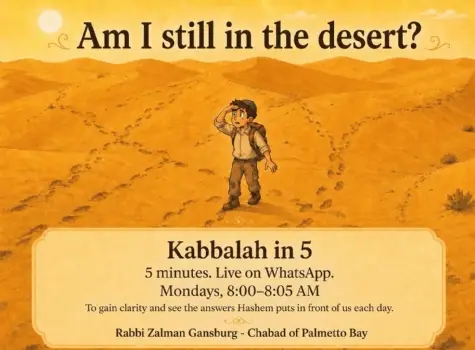 As a Jewish nation we went through 3 stages.
Monday, April 27
- 40 years have passed, and we are still carrying the pain of one sentence.
- Maybe they don’t even know they hurt us.
- Maybe they are not even in our life anymore.
- But inside, we are still going back to that moment.
- This week’s Parsha teaches us the mitzvah of Shichecha.
- When a person harvests his field and forgets some stalks, the Torah says:
- Leave it there for the poor.
- Rashi says something amazing:
- When a person fulfills this mitzvah, it is as if he built the Beis Hamikdash.
- Because this is not easy.
- A person worked hard on his field.
- He invested time, money, and energy.
 When someone is not yet well, we say the Mi Shebeirach blessing at the Torah.
Monday, April 20
- We wake up in the morning
- and we have so much on our minds.
- has their own challenges.
- But it still feels like a lot.
- how am I supposed to juggle all of this?
- When the mind has too much—
- It is just feeling overwhelmed.
- We hope things will somehow work out.
- There are two types of p…
Monday, March 23
- On Pesach, we are only allowed to eat matzah — representing humility, acceptance, and faith.
- On Shavuot, by contrast, in the Beit Hamikdash we brought the offering of two loaves of bread — representing understanding, depth, and intellect.
- When building a nation, a relationship, or educating a child — first comes faith and humility, and only then intellect and understanding.
- This is why Pesach comes before Shavuot.
- A person can spend a lifetime lost when when his or her choices begins with intellect instead of acceptance.
- Sometimes you are right — and YOU choose to give in.
- Sometimes you are tired — and YOU choose to listen.
- Sometimes you want to be alone — and YOU choo…
Monday, March 2
- Why is it that the people we love the most are often the ones we struggle with the most?
- With people who are more distant, there are no expectations.
- Expectation creates disappointment.
- Disappointment is the beginning of the struggle.
- Haman was happy when his lottery fell on Adar because he knew that in Adar Moshe passed away.
- But he did not realize that in Adar was also Moshe’s birthday.
- What’s the connection between Haman and Moshe?
- Moshe was the most humble person who ever lived, and Haman was all about his ego.
- The fact that he was not able to tolerate Mordechai was because Mordechai did not bow down to him. It was not about religion. It was about his ego.
- He needed recognition, honor, and …
Monday, February 23
- If someone offered you great success a secure future, a big name, real influence but someone close to you would be hurt or left behind…
- “I will destroy them, and I will make you into a great nation.”
- “If You do not forgive them,
- erase my name from Your book.”
- And in this week’s portion,
- Moshe’s name is not mentioned.
- and “I will make you great” were said in one breath.
- Not step one and then step two.
- Moshe understood something very subtle:
- If my greatness is mentioned toge…
February 17, 2026
- then shouldn’t everyone be the same?
- But the Torah says the opposite.
- Precisely because Hashem is One
- each person has a unique mission.
- The heart is not the brain.
- The foot is not the hand.
- I have a unique place in this world.
- when there is no clear boundary.
- In the Mishkan, ( Tabernacle) everything had a place.
- The High Priest went to specific places in specific time…
February 10, 2026
Friday, February 6
- התורה מתחלקת לשלושה חלקים
- The Torah is divided into 3 parts: Torah, Prophets, and Writings.
- The Jewish people are divided into 3 groups: Kohen, Levi, and Israel.
- התורה ניתנה על־ידי משה, שהיה השלישי במשפחה: מרים, אהרן ומשה
- The Torah was given through Moshe, who was a 3rd sibling: Miriam, Aaron, and Moshe.
- התורה ניתנה לאחר שלושה ימים של פרישות וטהרה
- The Torah was given after 3 days of separation and spiritual preparation.
- והיא ניתנה בחודש השלישי – חודש סיוון
- And it was given in the 3rd month, the month of Sivan.
- דיברנו על ההבדל בין עולם התוהו לעולם התיקון
- There is the World of Chaos (Tohu) and the World of Rectification (Tikun).
How To Join Live Voice Chat
Monday, January 25th
- When a child misbehaves, we usually see only two options.
- כשהילד לא מתנהג בצורה נכונה , אנחנו חושבים בדרך כלל רק על שתי אפשרויות
- Either fight it strongly, or ignore it and give up.
- או להתנגד בצורה נחרצת , או להעלים עין ולוותר
- But maybe there is a 3rd option?
Read on JewishPalmettoBay.org